


My mammogram found something. What happens next?
If your mammogram or ultrasound found an area that needs a closer look, the next step is usually more imaging, and sometimes a biopsy. Breast MRI is the exam radiologists turn to when a finding is unclear, when the extent of a known cancer needs to be mapped, or when a woman’s risk is high enough that mammography alone is not enough [1]. When the area of concern can only be seen on MRI, an MRI-guided breast biopsy is the way to sample it [2]. Greater Waterbury Imaging Center performs both breast MRI and MRI-guided breast biopsy in Waterbury, on physician referral.
Each October, Breast Cancer Awareness Month reminds us why early detection matters. Breast cancer remains the most frequently diagnosed cancer among women in the United States and the second leading cause of cancer death in women. The American Cancer Society reports that about one in eight women will develop invasive breast cancer during her lifetime, and survival is far higher when the cancer is found early [3].
This year’s post keeps the awareness basics and adds the part patients ask us about most: what happens after a screening exam raises a question.
Know your breast cancer risk factors
Being female and getting older are the two strongest risk factors. Several others raise risk, and some can be changed:
- Beginning menstruation before age 12, or entering menopause after age 55
- Long-term hormone replacement therapy
- A family history of breast cancer, especially in a parent, sibling, or child
- Dense breast tissue, or a prior breast cancer diagnosis
- Radiation therapy to the chest before age 30
- Excess weight after menopause
- A known BRCA1 or BRCA2 gene change
Women at high risk, which the American Cancer Society defines as a lifetime risk of roughly 20 percent or more, a known BRCA1 or BRCA2 change, or chest radiation before age 30, are advised to have a breast MRI and a mammogram every year, typically starting at age 30 [1]. If several of these apply to you, ask your doctor about a formal risk assessment and genetic counseling. Our earlier post covers BRCA gene changes and breast cancer risk in more depth.
Recognizing the signs
Early breast cancer often causes no pain and no visible change, which is why screening finds most cancers before a patient can feel them. Contact your healthcare provider if you notice:
- A new lump in the breast or underarm
- Thickening, swelling, or dimpling of the skin
- A change in breast size, shape, or symmetry
- Nipple retraction, flaking, or unexplained discharge
Most of these changes turn out to be benign. They still deserve a prompt evaluation. Read more on breast cancer risk factors and screening recommendations.
Reading your report: what the BI-RADS score means
Every breast imaging report, whether from a mammogram, an ultrasound, or a breast MRI, ends with a BI-RADS category from 0 to 6. The number tells you and your doctor what comes next:
- 0, Incomplete: more imaging is needed
- 1 and 2, Negative or Benign: routine screening continues
- 3, Probably Benign: short-interval follow-up, usually six months
- 4, Suspicious: a biopsy is recommended
- 5, Highly Suspicious: a biopsy is recommended and treatment planning may begin
- 6, Known Malignancy: cancer already confirmed by biopsy
A BI-RADS 4 or 5 on a mammogram or ultrasound usually leads to a biopsy guided by that same exam. A BI-RADS 4 or 5 on a breast MRI, for a finding that mammography and ultrasound cannot see, is where MRI-guided biopsy comes in [2]. Our guide to understanding your mammogram and BI-RADS assessment walks through each category.
When the next step is a breast MRI
Breast MRI uses a strong magnet and an IV contrast agent, with no radiation, to show blood flow and tissue detail that mammography and ultrasound cannot [1]. Your referring physician or breast imaging center may order it when:
- A mammogram or ultrasound finding is unclear and needs a second look
- A cancer has been diagnosed and the surgeon needs to know its full extent before planning treatment
- Your lifetime risk is high enough for annual MRI screening alongside mammography
- Breast implants need to be checked for rupture (GWIC performs implant integrity MRI)
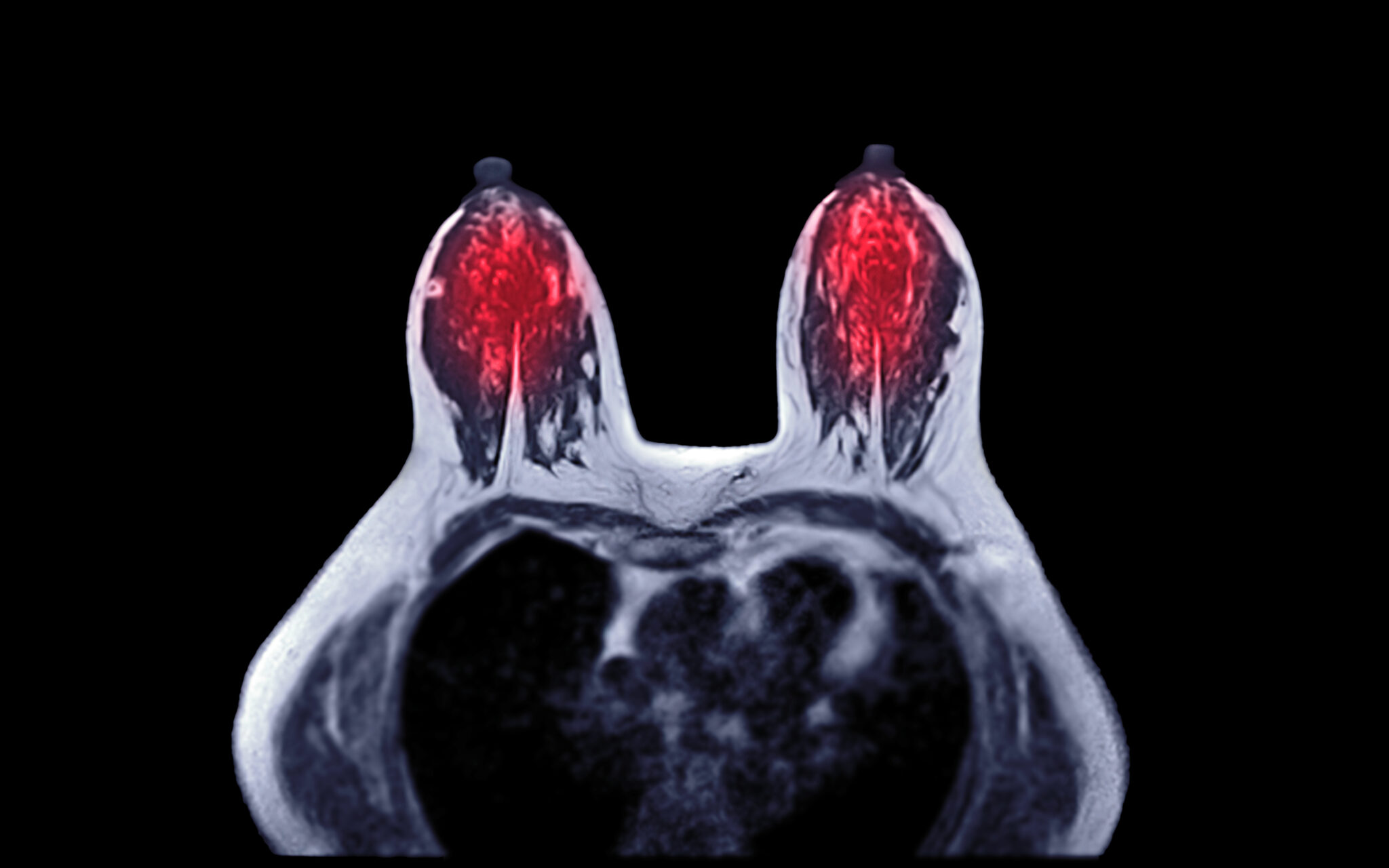
At Greater Waterbury Imaging Center, breast MRI is performed on a wide-bore 1.5T scanner with a dedicated breast coil, and the center holds ACR Breast MRI Accreditation through 2029. The exam takes about 30 to 45 minutes. You lie face down with the breasts positioned in the coil, and the contrast is given through a small IV. For how MRI helps map a known cancer, see Breast Cancer Detection and Staging: How Breast MRI Helps.
What an MRI-guided breast biopsy involves
An MRI-guided breast biopsy is a needle biopsy performed inside the MRI scanner, used when the area of concern shows up only on MRI [2]. The radiologist uses the MRI images to calculate the exact position of the finding, numbs the skin and breast with local anesthetic, and takes several tissue samples through one small skin nick with a vacuum-assisted needle. A tiny marker is usually placed at the site so the area can be found again on future imaging. The procedure takes about an hour, you are awake throughout with local anesthetic only, no stitches are needed, and most patients return to normal activity the next day [2]. A mammogram is taken immediately afterward at the hospital’s imaging center to confirm the marker’s position.
A pathologist examines the samples, and the radiologist confirms the result matches the images. Your referring physician receives the pathology report and reviews it with you.
Greater Waterbury Imaging Center performs MRI-guided breast biopsies on site. Your physician faxes the order, the center requests your prior imaging, and our scheduling team arranges the appointment and provides pre-procedure instructions.
Frequently asked questions

No. Greater Waterbury Imaging Center is an MRI-only center. Your mammogram and ultrasound are done at a breast imaging center, and your physician refers you to GWIC when breast MRI or an MRI-guided biopsy is the next step.
Yes. Breast MRI and MRI-guided biopsy are ordered by your physician or breast surgeon. Bring this page to your appointment if you want to ask whether MRI is right for your situation.
Plan on about two hours in all. You arrive 30 minutes early for check-in and screening, the biopsy itself takes about an hour, and you then spend about 30 minutes at the hospital’s imaging center for the mammogram that confirms the marker position. No sedation is used, so you can drive yourself home.
Yes. GWIC’s wide-bore 1.5T scanner has a larger opening than a traditional MRI, and our team works with patients who are anxious in enclosed spaces. See our claustrophobia page for what to expect.
Coverage depends on your plan and the reason for the exam. Our office verifies benefits before your appointment.
Greater Waterbury Imaging Center sets no medication requirements before the biopsy; eat normally and take your medications as usual. Tell the scheduler what you take, including aspirin, blood thinners, and supplements, and never stop a prescription medication without your doctor’s instruction. If your physician wants a blood thinner paused, that instruction comes from your physician.
If your report says biopsy, here is the next step in Waterbury
If your mammogram, ultrasound, or breast MRI report recommends further imaging or a biopsy, Greater Waterbury Imaging Center performs breast MRI and MRI-guided breast biopsy in Waterbury on a wide-bore 1.5T scanner, with evening and Saturday hours, on referral from your physician or breast surgeon. Ask your doctor to send the order to GWIC, or contact us, and we will help coordinate it.
Greater Waterbury Imaging Center provides breast MRI and MRI-guided breast biopsy for patients throughout Greater Waterbury. Our radiologists work directly with your referring physician so results reach you quickly and clearly. Contact us to learn more about breast MRI during Breast Cancer Awareness Month.
References
- American Cancer Society. American Cancer Society Recommendations for the Early Detection of Breast Cancer. Last revised July 23, 2026.
- Radiological Society of North America and American College of Radiology. MR-Guided Breast Biopsy. RadiologyInfo.org. Reviewed June 15, 2026.
- American Cancer Society. Breast Cancer Facts & Figures 2024–2025. Atlanta: American Cancer Society, Inc.; 2024.